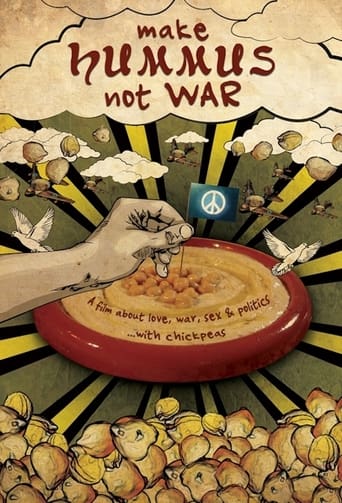
Filmmaker Trevor Graham is an Australian 'hummus tragic'. Every week in his Bondi Beach home he observes the hummus making ritual, mashing chickpeas, lemon juice, garlic and tahina. But when the Hummus War erupted in 2008, among the usual suspects, Israel, Lebanon and Palestine, Graham was hungry for more. But this war ha no soldiers, bullets or tanks. Just chickpeas and hummus. Make Hummus Not War is a humorous homage to the chickpea's most distinguished dish. But there's a personal story, how Graham became a hummus tragic, a father who served in Palestine during WW2 and two lovers in his life, one Syrian, one Jewish, with whom he shared a great culinary passion.
After receiving devastating news one morning, Esther, a silent young girl, goes through her daily routine while a darker reality gradually unfolds.
An infinite Minecraft hellscape with no end in sight, everyone and everything trapped in complete and utter pain and torture forever and ever. So many soldiers in a row, all equally losing what it is they have left worth fighting for. When it comes down to it, how far are you willing to go and still justify it as warfare? Let's find out. Again and again...
Based on a novel by Ismail Kadare. A group of partisans is tasked with reestablishing Radio Tirana.
A patriot risked his death to assassinate a Japanese staff officer, hiding the secret information of the Japanese army's military operations in Shanghai in the "Centennial Tai Sui", and the Zhang family father and daughter secretly sent the "Hundred Years Tai Sui" to Shanghai. When they arrived in Shanghai, the father and daughter of the Zhang family died mysteriously, and Qin Taisui, an apprentice in the theater class, was inadvertently involved in this murder case, and the "Hundred Years Taisui" fell into the hands of Shanghai gangster Zhuo Yifan and was auctioned at a high price. At the same time, Qin Taisui, who wanted to clear his grievances, began to investigate the truth of the matter, joined forces with the patriotic anti-Japanese secret organization, and fought fiercely with the Japanese secret agencies to recapture the secret military intelligence, and finally walked towards the bright road through the baptism of blood and fire.
About the struggle of steelworkers and residents of the city of Mariupol against the German fascist invaders during World War II.
A friendship relationship develops between the child Mamdouh, the son of a wealthy family, and Fathia, who is from a poor family. Days go by and the two children, Mamdouh and Fathia, separate. Mamdouh becomes an officer in the army, while Fathia, after losing her family, works in a cabaret. Mamdouh and Fathia meet after all these years and return to the memory of the past. So he decides to marry Fathia.
Germans come amid snow and winter. In the village only people remained are women, that fight until wounded partisans, sheltered in the village, will retreat deeper and snow will cover their tracks. Face to face with the Germans and their control of the village, women, led by mother Shano and mother Mara, depart to make a pile of wood, but actually bring bread and food to the partisans.
Through a series of vignettes from the ancient and war-torn Levant, WILD IS THE SPRING captures moments in the lives of diverse ethnic communities who struggle to survive when life descends into chaos.
The story of Ramiro, a young boy, who is leaving to war; his return and his missing with the love of his life, Laurinda.
Where does submission to authority end? Where does individual responsibility begin? Each person confronted with violence asks themselves these questions. Through the testimonies of conscripts but also of Algerian activists, a memory of this war is constructed. The atrocities of the Algerian war are known. However, conscripts were pressured not to speak out upon their return. General de Bollardière was punished for opposing torture. Guy Mollet, President of the Council, denied any shameful practice before Parliament…
During World War II, Japanese soldiers set up bases in Thailand to fight the war. The Thai government had to give in and cooperate with Japan. However, many movements arose to resist the Japanese army in order to protect and preserve Thai identity.
A look at the incidents of June 25, 1950 which marked the beginning of the Korean War and which found the South to be woefully unprepared.
Historical Epic about The Voortrekkers
Activate Your Account!
You must create an account to continue watching